
Step into a real indoor cannabis cultivation facility in LA and you'll notice three things before anyone speaks. First, the air is precise — 68°F, 55% humidity, a constant low hum from HVAC and dehumidifiers. Second, the light is unnatural — purple and red LEDs at exactly the wavelength chlorophyll absorbs best. Third, the room is clean. Stainless steel benches, sealed floors, no airflow that hasn't been HEPA-filtered.
That's what "indoor cannabis" actually means. Not a plant in a basement. A controlled environment where every variable that affects trichome density — temperature, humidity, light spectrum, light cycle, soil chemistry, CO2 level — is measured and dialed in.
This guide walks through what indoor cultivation actually does to the plant, why it produces measurably different flower than greenhouse or outdoor grows, and how to tell when a product label is lying about being indoor.
What "indoor" specifically means in the cannabis industry
Three cultivation environments produce the cannabis you buy:
| Type | Environment | Light source | Typical price/lb (wholesale) |
|---|---|---|---|
| Outdoor (sun-grown) | Open-air field | Sun only | $200–400 |
| Mixed-light / dep | Greenhouse | Sun + supplemental lights | $300–500 |
| Indoor | Sealed room, no natural light | Full-spectrum LED or HPS | $850–1,400+ |
The price ladder is real and consistent across markets because each environment produces materially different flower. Outdoor flower is bigger-yielding per plant but has lower trichome density and lower terpene retention (UV exposure + variable weather degrade volatile compounds). Mixed-light is the compromise — better than outdoor but inconsistent batch-to-batch because sunlight isn't controllable. Indoor is the gold standard because every variable is controlled.
We covered the mixed-light vs indoor smalls economics in our trending-smalls breakdown — that's the math behind the $300-500 indoor-smalls flip play.
The process — seed to cure, what each phase changes
Phase 1: Genetics selection (Week 0)
Indoor cultivators start with clones from a verified mother plant, not seeds. Why: seeds are genetic lottery; clones are genetic copies of a phenotype the cultivator has already selected for specific terpene production, growth pattern, and resilience. Every Apple Fritter flower we stock comes from the same mother-plant lineage, so the smoke profile is reproducible across batches.
Outdoor growers can't always afford to be this picky. Indoor's the rare environment where genetic precision is feasible.
Phase 2: Vegetative growth (Weeks 1–4)
Clones go into a sealed veg room with 18 hours of light, 6 hours of dark. The light cycle tricks the plant into staying in growth mode (not flowering) so it builds biomass. Indoor veg rooms keep humidity at 60–65% to encourage healthy leaf growth without inviting mold.
This is where indoor diverges from outdoor most visibly: outdoor plants experience natural day-length variation as the season progresses, which means veg duration is dictated by the sun. Indoor cultivators decide veg duration based on the strain — typically 3–5 weeks for premium phenos that need to develop strong vascular structure before flowering.
Phase 3: Flowering (Weeks 5–12)
The light cycle flips to 12 hours on, 12 hours off. This simulates fall and triggers the plant's reproductive phase — trichome production, terpene biosynthesis, cannabinoid generation. The flowering room runs slightly cooler than the veg room (~68°F) and slightly drier (~50% humidity) to maximize trichome density.
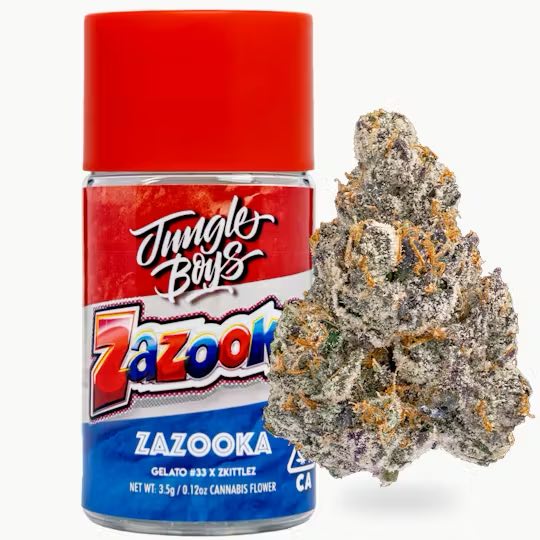
This is the phase where premium genetics show their value. A strain like Pink Bubblegum or Jungle Boys top-shelf develops the trichome coating you see on the jar — that white frost coverage — in weeks 8–10 of flowering. Outdoor plants get the same trichomes but with less density per gram because outdoor light intensity varies by day, and trichome production correlates directly with consistent high-intensity light.
Indoor LED setups deliver 800–1,200 PPFD (photosynthetic photon flux density) for 12 hours straight, every day. Outdoor plants peak at that intensity for maybe 4–5 hours mid-day. The trichome math follows.
Phase 4: Harvest + dry (Days 1–10 post-harvest)
The plants are cut, hung upside down in a dark drying room at 62°F and 60% humidity, for 7–10 days. This phase is where outdoor and indoor producers most often differentiate: indoor operations have the budget and infrastructure to control drying conditions precisely. Outdoor operations sometimes rush this phase to maximize harvest velocity, which damages terpene retention and produces harsher smoke.
Phase 5: Cure (Weeks 1–8 post-dry)
Now the flower goes into sealed jars (or large food-grade vacuum bags) and is "burped" daily for the first two weeks, then weekly afterward. Burping = opening the jar to release trapped moisture and CO2 (a byproduct of microbial metabolism on residual sugars in the plant).
This is the make-or-break phase. Premium cultivators like the source farms behind Jungle Boys, Super Dope, and Bounty Snowcaps cure for 6–8 weeks minimum before any product leaves the facility. Most commercial cannabis cures for 7–14 days because the volume math doesn't allow longer.
The difference shows up in three ways:
- Smoothness on the throat — long-cured flower doesn't make you cough on the first hit
- Trichome integrity — properly cured trichomes hold their shape and don't degrade into less-active CBN
- Combustion behavior — a properly cured bowl burns evenly with white ash; a rushed cure burns hot, fast, and leaves black ash
We went deep on the cure-quality science in the Jungle Boys review. Worth reading if you want to understand why indoor commands the premium.
How to spot fake-indoor in the wild
Cultivators sometimes label outdoor or mixed-light flower as "indoor" because the price multiplier is enormous. Six visible tells:
- Trichome density — Real indoor flower looks like it's been rolled in powdered sugar. Outdoor often has trichomes only on the bud surface, with the inner structure looking matte. Crack a bud in half: indoor stays frosted inside; outdoor doesn't.
- Bud shape — Indoor produces dense, tight, manicured buds. Outdoor buds tend to be larger but airier and less manicured.
- Color uniformity — Indoor flower has consistent coloration across the whole bag. Outdoor flower shows leaf browning, sun spots, and color variation from where the bud was in the canopy.
- Aroma — Indoor flower hits the nose loud the second you open the jar. Outdoor's aroma is muted from UV degradation of volatile terpenes.
- Smell after combustion — Real indoor flower smells like the strain when you smoke it. Mislabeled outdoor smells generic.
- Price — Outdoor sold as indoor at $1,200/lb wholesale is the giveaway. Real indoor at that price tier exists ([our $850-1,400 range covers it](/)). Cheaper than that, "indoor" label is suspect.
Why we exclusively stock indoor (and mixed-light for value)
Our entire flower catalog is indoor or mixed-light. No outdoor. Two reasons:
- Trichome density = effect quality. Indoor flower at 26% THC + 3% terpenes hits qualitatively different from outdoor at the same THC% but 1.5% terpenes. The high feels fuller, the body experience is richer. We covered the terpene-amplification effect in detail.
- Consistency across batches. Indoor cultivators can reproduce the same phenotype expression month after month. Outdoor varies seasonally. For a distro running consistent customer orders, indoor's reproducibility is essential.
Browse the [main flower menu](/) and you'll see this throughout — every product page lists whether it's indoor or mixed-light, and the indoor products carry the matching trichome density and price.
The 5 indoor strains worth your first jar
If you've been smoking mid-range flower and want to step up to genuine premium indoor, these are the picks:
- Apple Fritter — S-tier indoor, 28-31% THCA, the bakery-nose indica connoisseurs return to. Full review here.
- Sundae Driver — A-tier indoor hybrid, dessert-terp profile, functional heavy. Full review.
- Pink Bubblegum — candy-nose hybrid, frosted indoor, high-20s THCA.
- Wake & Bake — daytime sativa-leaning indoor, mid-20s THCA, pinene-forward. Full review.
- Jungle Boys — top-shelf indoor, premium genetic library, 6-8 week cure standard. Full brand guide.
The honest comparison: indoor vs concentrates
Once you've smoked premium indoor enough to develop a palate, the next step is usually hash rosin or live resin. These are concentrates pressed from premium-indoor starting material — same terpene profile, 3-5x stronger per gram.
But concentrates are not a replacement for flower. They're a different tool for different moments. The full-spectrum experience of premium indoor flower remains the canonical cannabis experience. Concentrates are an extension of it, not an upgrade.
Read Next
- Why Quality Cannabis Actually Matters — what cheap flower hides
- Jungle Boys Review — premium indoor benchmark
- What Are Terpenes? Complete 2026 Guide — the chemistry
- Trending Indoor Smalls (MI/FL/MS/CT) — the value tier
- Strongest Weed Strains 2026 — Tier List — premium indoor ranked by potency
Written by
Real Duck Distro Editorial Team
Cultivators, extract chemists, and cannabis writers based in Los Angeles, California — collectively 25+ years in the California cannabis industry. Every product we write about is one we've handled, tested, and stocked. Honest reviews, practical guides, real experience.
Specialties: California cultivation · Extract chemistry · Strain genetics · Disposable hardware · Harm reduction · Edibles dosing
Read Next
Keep going — we picked these for you
Live Resin vs Live Rosin (2026): The Real Difference & Which Is Worth Your Money
Live resin vs live rosin: one uses solvents, one uses only heat and pressure. The real difference in flavor, potency, purity and price for 2026.
Read article
Cannabis Terpenes Explained (2026): The 8 Aromas That Actually Shape Your High
Terpenes shape cannabis aroma, flavor and effect. Here's what myrcene, limonene, caryophyllene and 5 more do — and how to shop by terpene in 2026.
Read article
The 2026 July 4th Cannabis Guide: Strain Picks, BBQ Pairings & Discreet Family-Hang Tactics
July 4th rewards smart cannabis planning. The wrong strain at the wrong hour ruins the day. Here's the 2026 hour-by-hour guide — daytime picks, BBQ pairings, fireworks finishers, and how to keep it discreet when your aunt asks what you're smoking.
Read article